
Living with pulmonary fibrosis
Having a lung condition with pulmonary fibrosis can be challenging, but there are many ways to help manage your condition and continue living your life.

Mental well-being
Community and support groups
A diagnosis of pulmonary fibrosis can feel very isolating. It is important to remember that you are not alone. Many people have had experiences similar to yours, and they often come together at support groups. Patient support groups are a valuable resource to help you through your journey.
Participating in a patient support group can help you:
- Connect with others who are facing similar experiences
- Share ideas and strategies for managing your physical and mental health and the everyday challenges of living with pulmonary fibrosis
- Feel the comfort of knowing that you are not alone
Online resources
As well as patient support groups that you can attend, there are also online groups where you can connect with other patients like you. Patient organisations support people with pulmonary fibrosis by having online groups where patients can connect with others who face similar challenges and also obtain information about living with the condition.
How can I find local and online patient support groups?
Your treatment team may be able to direct you to patient support groups in your area. Searching the internet can also provide you with information on online patient organisations and the support they provide.

Relaxation and mindfulness
Relaxation techniques can help balance the demands of managing pulmonary fibrosis, while trying to live life to the fullest. Your treatment team may discuss different relaxation techniques with you that can help improve your mood and sense of well-being.
Using relaxation techniques1
When you feel physically and emotionally relaxed, your muscles are relaxed, too. This means that your muscles need less oxygen and your breathing may become more settled. There are many different relaxation techniques which you can try, including mindfulness and meditation.
Practicing relaxation techniques can have many benefits, such as1:



Simple relaxation exercises for managing pulmonary fibrosis
Below are 2 simple relaxation exercises to help both your mind and body.
60-second relaxation
- Sit down in a comfortable chair
- Breathe in deeply
- Take a few slow, deep breaths and quietly say to yourself, ‘I am’ as you breathe in
- Breathe out
- Then say, ‘at peace’ as you breathe out
- Repeat this slowly 2 or 3 times. You should start to feel your body relax into the support of the chair
2-minute relaxation
- Sit down in a comfortable chair
- Breathe in
- To begin, breathe in deeply saying, ‘10’ to yourself
- Breathe out
- Then breathe out slowly
- Count down
- On your next breath, say ‘9,’ and continue counting down to ‘0’
- When you reach ‘0,’ you should feel more relaxed
Exploring mindfulness and meditation
Conditions like pulmonary fibrosis can cause added worry and anxiety about the future and making it hard to focus on the important things in life.2
Mindfulness is a very simple form of meditation and can help you keep a positive attitude and manage any difficult emotions when you experience them. You can practice mindfulness in any environment, position, or manner that is most comfortable to you—it is not about ‘success’ or ‘failure’ but rather reducing your fears and allowing your mind to focus.
What are some of the benefits of practicing mindfulness?3
Mindfulness is about observation without criticism; being compassionate with yourself when unhappiness or stress are bothering you. Mindfulness allows you to catch negative thought patterns before they tip you into a downward spiral. It begins the process of putting you back in control of your life.
Some of the benefits of mindfulness include3:
- Improved happiness and well-being
- Reduced stress, anxiety, and irritability
- Improved memory, creativity, and reaction times
How do I perform mindfulness?
There are many ways of performing mindfulness. Some people like to take part in guided mindfulness, where a teacher (or a recorded voice) will talk you through a mindfulness session. Most sessions focus on clearing your mind and allowing you to think clearly. They can last anywhere from 5 minutes to 1 hour.
One very simple example of a mindfulness session would be:


Quick tip
Most relaxation exercises are safe for most people. However, just like with exercise routines, people with pulmonary fibrosis should discuss the relaxation techniques with their treatment team before commencing a program.
Coping with a serious lung condition
Receiving the news that you have pulmonary fibrosis can come as a shock. After the diagnosis, it is normal to feel a range of emotions.
Give yourself the time to take in what is happening. Some people would rather be on their own, whereas others would rather spend time with family and friends. If you don’t feel like talking right away, you don’t have to. At some point, though, it’s important to express how you feel.
Talking with friends and family about your diagnosis
You may find it difficult to talk with your family and friends about pulmonary fibrosis. Yet being open about your condition can help both your physical and mental well-being.
Most people have never heard of pulmonary fibrosis and are not aware what you are going through. Through learning more about your condition, you will find it easier to explain it to others. You should also consider changing the way you explain pulmonary fibrosis depending on who you are talking to.

When explaining pulmonary fibrosis to young children, consider saying:
“My lungs work differently now. You may have seen that I move a little slower and that my breathing sounds different.
I still want to play with you, but you may need to be a bit patient while I catch my breath.”
When explaining pulmonary fibrosis to older family members and friends, consider saying:
“You may have noticed that I move a little slower than before and that my breathing sounds different. My lungs work differently now because I have a condition called pulmonary fibrosis. This means that there is scarring in my lungs which causes me to feel breathless. I do have support from my treatment team and it’s important that I take care of myself.”

Things to keep in mind when dealing with pulmonary fibrosis
You are not alone
Pulmonary fibrosis is considered rare, but it still affects millions of people around the world.
Help is out there
Participating in a patient support group may help you to better manage the challenges of living with pulmonary fibrosis.4
Hope is contagious
Maintaining a sense of hope for the future will help you focus on looking after your physical and mental well-being. You may find hope from members of a support group—and in turn, you may one day provide hope for someone else.
Dealing with depression
It is normal to feel low after diagnosis. Learn about how to be aware of your feelings and when to see a healthcare professional
Dealing with pulmonary fibrosis can take a heavy emotional toll. You may fear losing the ability to function without help and worry about having to rely on others.5 It is important that you do not isolate yourself from family and friends, as this can lead to feelings of sadness, low mood, and in some cases, depression.
Feeling low while living with pulmonary fibrosis
Most people with pulmonary fibrosis will experience a variety of emotions that can change gradually.5 Sometimes people say that their sadness lessens with time. This doesn’t mean that you will stop worrying or feeling upset. But these feelings can become more manageable. You might be able to think about your situation a little more calmly and plan what you want to do.
Feeling low is not a sign of weakness. Many people diagnosed with a serious illness have similar feelings and experiences. Keeping open communication with family, friends, and your treatment team is very important as they can help you to manage your mental well-being.
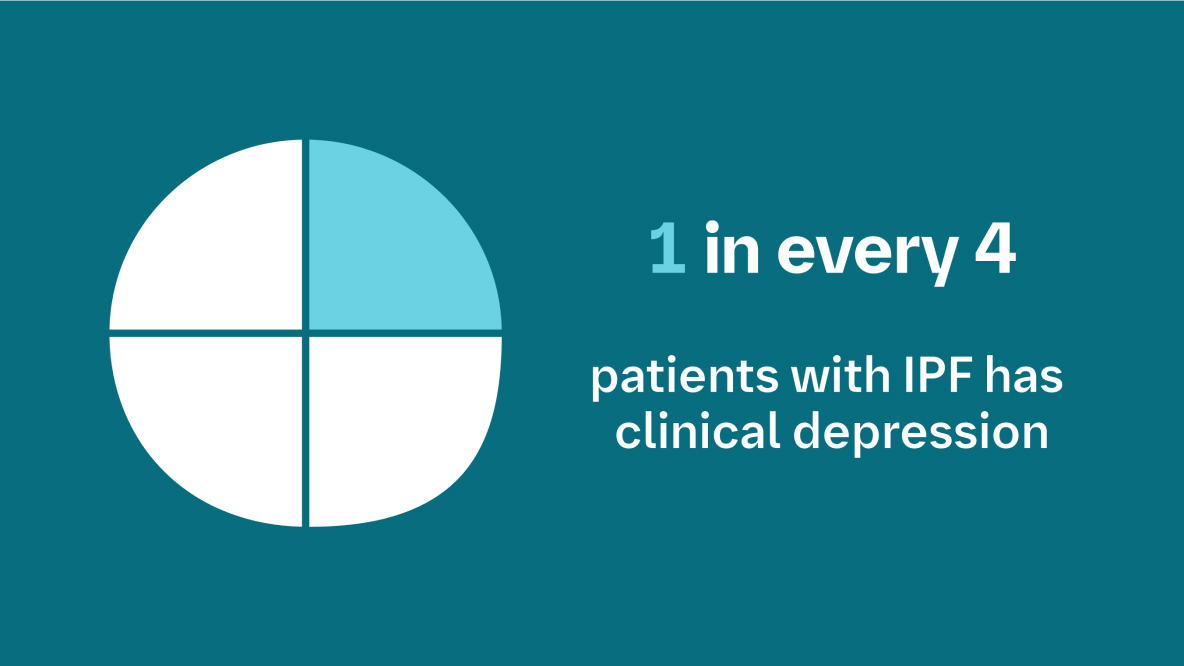
How do I know if I am depressed?
A doctor will be responsible for diagnosing clinical depression. If you or your carer notice any of the following symptoms of depression, talk to your treatment team:
- Daily sadness
- Loss of interest in friends and hobbies
- Irritability and anger
- Sleep problems and lack of appetite
It can be helpful to keep a diary of any symptoms of depression so that you can track how long you’ve been having them. Take these notes to your treatment team at your next appointment.
Speaking to a mental health professional
You should not have to manage this alone. As part of your treatment, you may need to speak to a professional counsellor.6 They may suggest different options to help you cope with depression that best suit you, such as relaxation techniques, exercise, or medication. A psychiatrist, psychologist, or support group can also help you cope if you have feelings of anxiety and depression.
Medications may be the right treatment option for your depression. Speak openly to your treatment team about any feelings you have to see if antidepressant treatments are right for you.
Abbreviations: ILD, interstitial lung disease; IPF, idiopathic pulmonary fibrosis; PF, pulmonary fibrosis; RA-ILD, rheumatoid arthritis-associated interstitial lung disease.
-
Mayo Clinic. Relaxation techniques: try these steps to reduce stress. January 24, 2024. Accessed October 2, 2024. https://www.mayoclinic.org/healthy-lifestyle/stress-management/in-depth/relaxation-technique/art-20045368/
-
The King’s Fund. Long-term conditions and mental health: the cost of co-morbidities. February 2012. Accessed October 2, 2024. https://assets.kingsfund.org.uk/f/256914/x/a7a77f9f6b/long_term_conditions_and_mental_health_february_2012.pdf
-
Davis DM, Hayes JA. What are the benefits of mindfulness? A practice review of psychotherapy-related research. Psychotherapy (Chic). 2011;48(2):198-208.
-
Pulmonary Fibrosis Foundation. Information guide. Accessed October 2, 2204. https://www.pulmonaryfibrosis.org/docs/default-source/programs/educational-materials/pf-information-guides/pf-info-guide.pdf
-
Russell AM, Ripamonti E, Vancheri C. Qualitative European survey of patients with idiopathic pulmonary fibrosis: patients’ perspectives of the disease and treatment. BMC Pulm Med. 2016;16:10.
-
Mental Health Foundation. How to look after your mental health. Accessed October 2, 2024. https://www.mentalhealth.org.uk/publications/how-to-mental-health/